


How To: Handle Micro Fasteners
How To: Handle Micro Fasteners
 Devices and technology are getting smaller. Even with growing screen sizes, internal components are constantly getting thinner. Space is a premium inside digital consumer devices. So what holds these devices together? In some situations these devices are held together with clips internally molded into key components, but this often results in a device that is difficult, if not impossible to disassemble without causing cosmetic damage. The solution to this issue comes in the form of micro fasteners. These fasteners can be as small as 1mm in diameter, but they are not a simply scaled-down version of their larger counterparts. As fasteners are downsized to lengths as short as two millimeters with thread sizes as small as M1.0, issues related to materials, tight tolerances, and torque control become magnified. Installation of micro fasteners poses the next set of challenges. With such tight tolerances and micro screw sizes, installation system accuracy must be increased when producing integral components of the feeding and insertion devices used to work with these fasteners. For feeding equipment, accuracy and adjustability are key factors in their performance. All Weber Micro feeding solutions come equipped with micro adjusting escapement systems that allow for extremely accurate positioning between the escapement and track position. This is one of the major contributors to the accuracy and reliability of our precision micro feeding technologies. Other factors that don’t normally affect screwfeeding applications come into play are materials, mass and electromagnetic or electrostatic fields. Standard feeding applications typically use what’s called a coil based vibrating solenoid partnered with a set of angled leaf springs to produce vertical and radial vibration causing the fasteners to move around the feeder bowl.
Weber Screwdriving Systems Inc. has incorporated micro piezoelectric technology into its micro feeding solutions. The science behind piezo technology incorporates piezoelectric crystals that vibrate at different frequencies depending on the voltage & current being passed through them, rather than using electromagnetic coils. Weber USA undertook the development of a new version of the piezo feeder which would move fasteners using micro-vibrations which are gentler on the small fasteners. This allowed the Micro Piezo feeder to successfully feed micro fasteners, pins, and other small shapes very quickly without any issues.
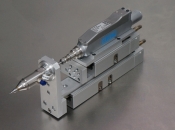
Driving and installation of micro fasteners requires a Micro screwdriving spindle with special features such as integrated vacuum due to their short length as the use of blow feeding delivery is, in many cases, not possible. So a pick & place vacuum spindle with extremely tight tolerances, special materials, and a low mass bit were developed which is capable of installing these fasteners with precision & repeatability. One of the major challenges in designing this spindle was the reduction of mass which resulted in low inertia to allow us to achieve the tight target torques desired without the issue of overshooting our torque target. Weight must also be reduced on all moving components when final torque is well below 1Nm. Overshooting the target isn’t the only problem plaguing micro fasteners. Often times the drag or resistance inside the spindle its self actually can cause incorrect torque readings by having drag values on the transducer. The friction in the spindle will actually reduce the final screw seating torque by the same value the friction produces. Typically this would not be an issue in larger screwdriving applications, but when torque and scale are reduced to the micro level, these factors are magnified. Weber Screwdriving Systems Inc. has managed to find a solution for all of these difficult screwdriving challenges when producing our Micro Screwdriving devices.
 nnrnnn nnrnnn